Bijoya Chaudhuri’s Recordings
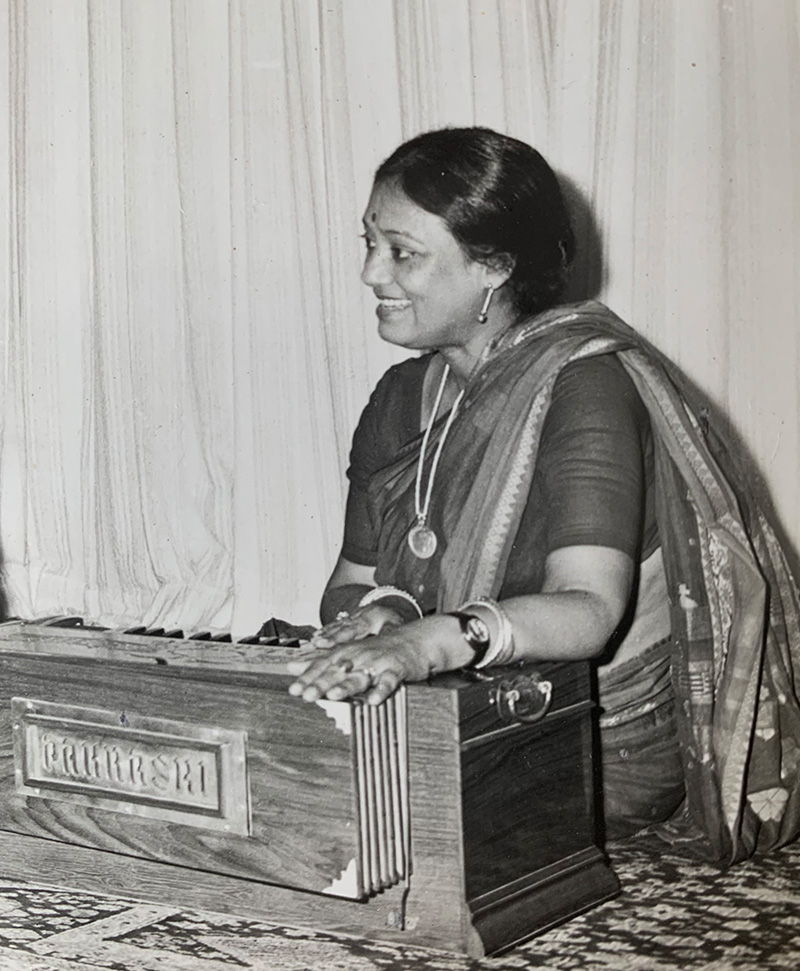
Bijoya Chaudhuri (born Bijoya Nandi Majumdar on 7th October 1925) made her first recording with HMV in 1965 under the supervision of Santosh Sengupta, four years after returning from London with her husband Nages Chandra Chaudhuri. By now, she was forty and a mother of a three-year-old son. Both life as a recorded singer and motherhood had begun late for her, but this first 78 rpm record of two Tagore songs, sandhya holo go o ma (‘Mother, evening is here’) and dukhero beshe eshechho bole (‘Though you’ve come to me in the guise of sorrow’), introduced to Bengal’s artistic landscape a new way of imagining the Tagore song, as a mesmerising pursuit of the purity of the musical note. This first record was followed in 1967 by what many consider her greatest recording, the remarkable esho nipabone (‘Come to the forest of nipabon flowers’), and – no less extraordinary in its melodious serenity – se je moner manush (‘He is the man of my heart’).
These would be followed by a series of recordings that covered decades, and which, taken together, are a reminder of Bijoya Chaudhuri’s exceptional artistry, the paradoxical convergence of a deep tonal maturity, boldness, and longstanding youthfulness in her voice, and her singularity as an interpreter of song. Although she was born into a family in Sylhet that was formed by the Tagorean ethos, Chaudhuri did not believe in being mainstreamed as a singer, exclusively, of Tagore songs. She was of a generation that inherited a significant repertoire of music, of many traditions and by many composers. Bijoya Chaudhuri tried to justice to this inheritance as an artist: her recordings include varied aspects of the modern Bengali song – Nazrul Islam, Atul Prasad Sen, Himanshu Dutta – and bhajans by Kabir, Meera, Tulsidas, Surdas, Nanak, and others.
Part of Chaudhuri’s aesthetic was to eschew overt, added emotion and to locate emotion not in the singer’s self-expression but in the musical note. As part of this project of ecstatic self-dissolution, she avoided vibrato and tremolo in her singing; yet it’s worth listening to her for the resonance vibrato is replaced with. Notes ring in her voice. Here are a few examples: in dukhero beshe, from her first 78 rpm record, the word hé at 1.24 minutes resonates. From her second 78 rpm recording, se je moner manush, the word aalo at 0.54-55 rings; so do raati at 1.00 and pathe at 1.41. In the same song, listen to the word daak at 0.24 for the purity of the seventh note in the lower register. The ringing is not the outcome of effort: it is the note sounding through the voice. Though it wasn’t deliberate but unasked-for, Bijoya Chaudhuri was aware of the resonance, and notes in her autobiography how it came to, and changed, both her voice and her life around the time she was sixteen. Suddenly, she could hear the ringing in her own voice.
Here is a selection of her recordings, to which we hope to keep adding more. Many of these songs will also be available from Gaana, Apple Music, and Spotify.
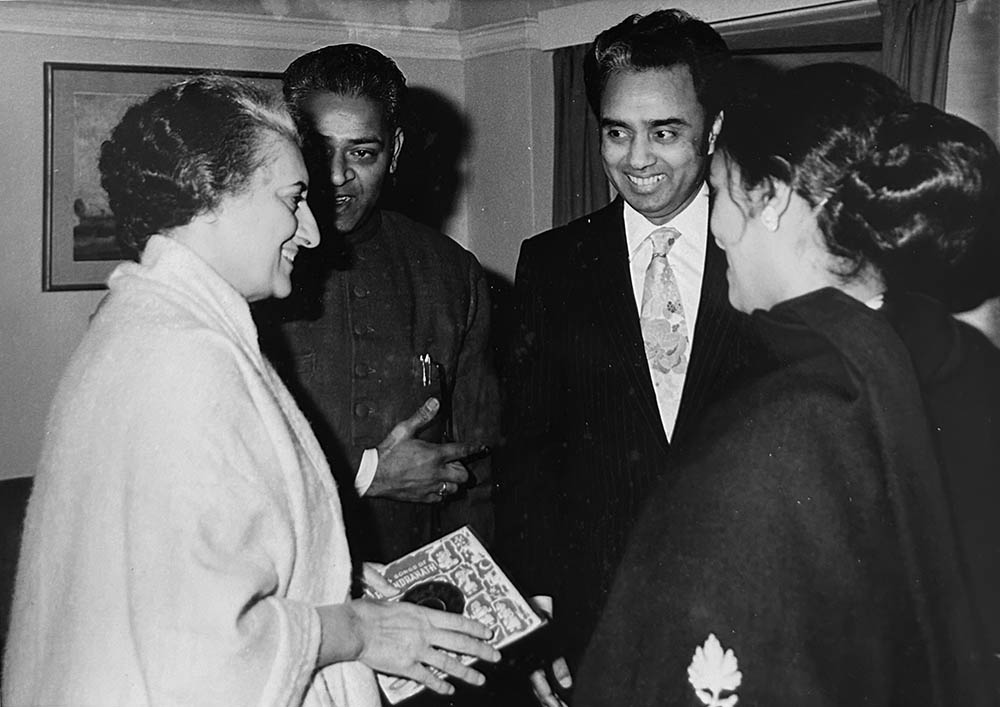
Bijoya and Nages presenting Indira Gandhi with her record, ‘Ogo shono ke bajaye/ Golapo phool phutiye achhe’ in 1970, New Delhi.
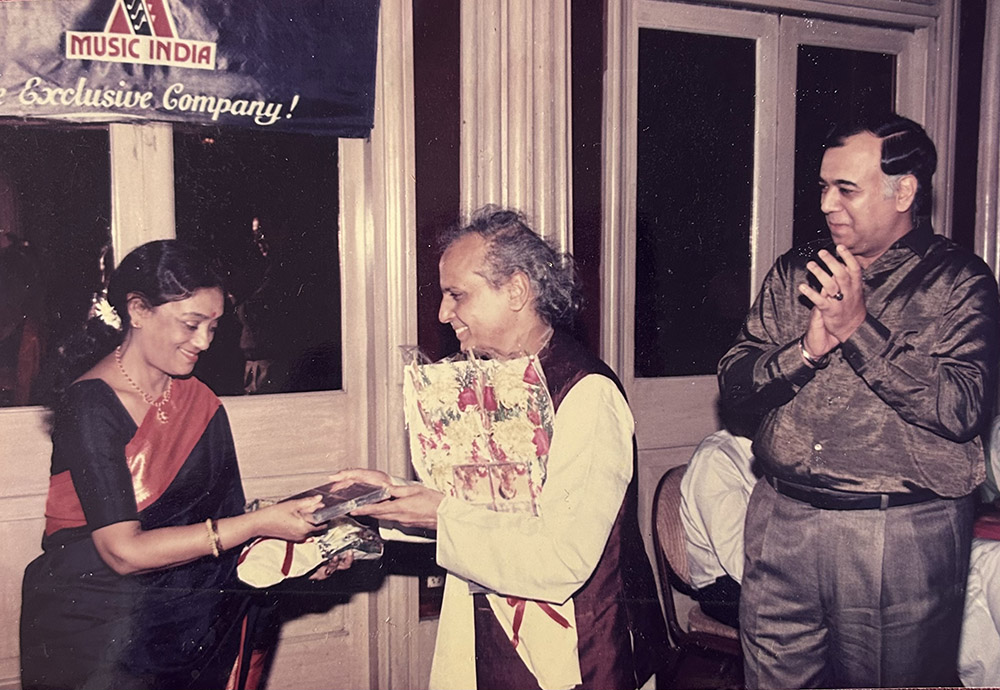
Pandit Jasraj releases Bijoya Chaudhuri’s album of bhajans, Bhakti Gunjan, 1988. On the right is Music India’s Vijay Lazarus.
Music
Tagore Songs
- 1. Sandhya holo go (HMV, 1965)
- 2. Dukhero beshe eshechho bole (HMV, 1965)
- 3. Esho nipabone (HMV, 1967)
- 4. Se je moner manush (HMV, 1967)
- 5. Ogo shono ke bajay (HMV, 1970)
- 6. Golapo phool phutiye achhe (HMV, 1970)
- 7. Se ashe dhire
- 8. Srabaner dhara mato
- 9. Sakhi pratidin hai (HMV, 1972)
- 10. Bhubaba jora ashana khani (EMI, 1974)
- 11. Tomari naam bolbo (EMI, 1974)
- 12. Ankhijala muchhaile janani (HMV, 1977)
- 13. Timiramaya nibida nisha (EMI, 1980)
- 14. Tumi ebar amay laho he nath (EMI, 1980)
- 15. Esho shyamachhayaghanaa din
- 16. Adheko ghume nayan chume
- 17. Nitya tomar je phool phote (Music India, 1985)
- 18. Dur deshi sei rakhal chhele (Music India, 1985)