
Bijoya Chaudhuri
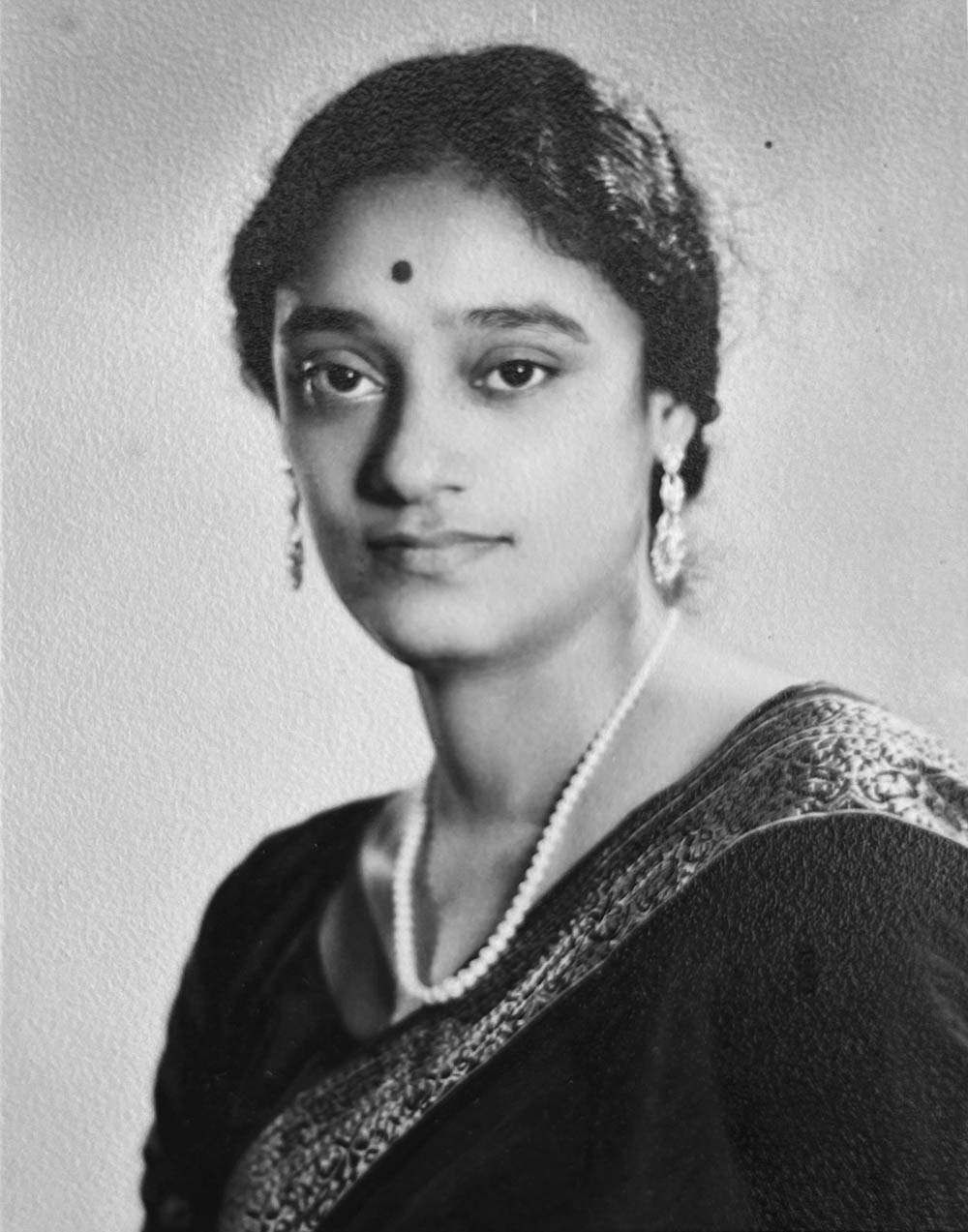
Bijoya Chaudhuri (born 7.10.1925; died 20.7.2016) was one of the most original 20th-century exponents of the Tagore song: the possessor of an exceptional voice as well as an acute critical intelligence that informed her approach to both music and the world. She was born on bijoya dashami (the tenth day of the Durga Puja festival, after which she was named), in Shibsagar, Assam, to a gifted and idiosyncratic family, the Nandi Majumdars, who fell into hard times after the death of their father, Jogesh Chandra Nandi Majumdar. Bijoya Chaudhuri (whose pet name was Khuku) was two years old at the time. The two sisters and five brothers – and two children from a previous marriage – were brought up in Sylhet by their mother, Sailabala Nandi Majumdar, by all accounts an extraordinary woman.
It was a family that was academically exceptional (except Khuku, who found schoolwork boring), imaginatively anarchic, nuanced and obsessive in its likes and dislikes, and immensely gifted musically. Bijoya began to learn singing from the well-known music teacher, Kumud Goswami, and became famous in Sylhet for her voice and singing, performing widely with her brother, Ashis Prasad Nandi Majumdar, in her teenage years. Together, they were known by their the rhyming pet names, ‘Khuku-Dukhu’. She would be chosen, after an audition, by the great singer and composer Dilip Kumar Roy to sing two songs with him in public when he was travelling in that part of India. Nevertheless, the family did not have the wherewithal to send her either to university (a lifelong regret for Bijoya) or to Tagore’s Santiniketan (which, for some reason, troubled her less).
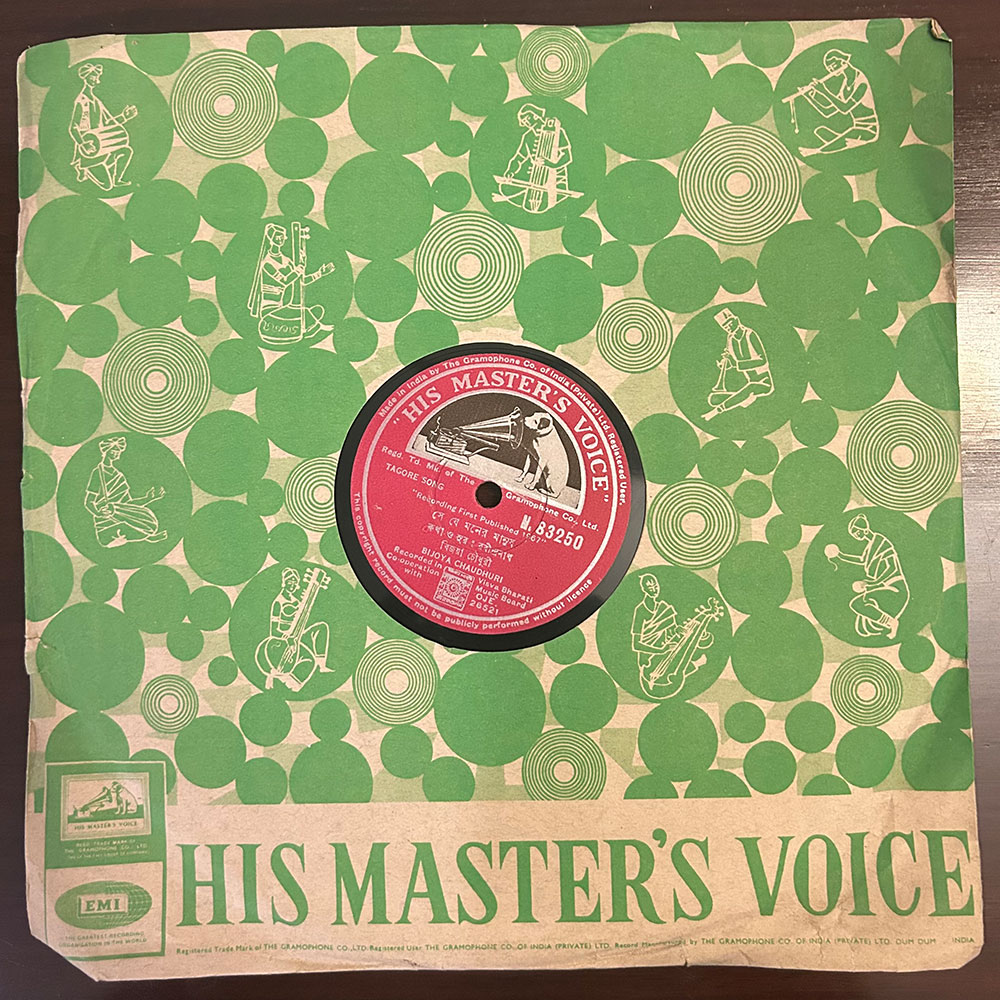
Se je moner manush, 1967, 78 rpm, HMV
In 1955, she travelled from Silchar (to which the family had moved after Partition) to London to marry Nages Chandra Chaudhuri, to whom she had been engaged, long-distance, since 1949, the year he had left Calcutta for England. Nages was her older brother Radhesh’s best friend, a fixture in the Nandi Majumdar family since Khuku, Nages, and Radhesh were children.
Returning to India in 1961, she gave birth to her only child, Amit, the following year in Calcutta. In 1963, after Nages joined Britannia Industries, they moved to Bombay, where they then lived for twenty six years. She began her illustrious, remarkable, and under-acknowledged recording career with a record from HMV in 1965 at the age of 40, travelling to Calcutta to record her Bengali albums largely out of the public eye. She was, nevertheless, esteemed greatly by peers like Kanika Bandhoyopadhyay and Dwijen Mukherjee, by critics like Amitava Chowdhury, and poets like Utpal Basu. Her principal mentor in presenting her songs to the world was the singer Santosh Sengupta. Later in life, she released an album under the supervision of Subinoy Roy, and another that was supervised by Arghya Sen. Santosh Sengupta and Subinoy Roy were, for her, key stylists in Rabindrasangeet.
Meanwhile, in Bombay she learnt Hindi devotionals and songs from various distinguished exponents, including Niaz Ahmed Khan, Yunus Malik, Vinayak Vohra, and, principally, from Pandit Govind Prasad Jaipurwale. Through the 1980s she recorded three albums from Music India of Hindi bhajans, Bhakti Dhara, Bhakti Nivedan and Bhakti Gunjan.
The rich trajectory of her life is captured by Bijoya Chaudhuri in her memoir, Sylhet Kanyar Atmakatha (The Autobiography of a Daughter of Sylhet), published by Anustup, and republished this year, which is the centenary of her birth. You can read an excerpt here, and the English translation here.
Her cooking was famous. See here for three recipes.